Monday, August 23, 2010

Economic capital by risk type

We have developed ‘economic capital’ as a consistent and comparable measure of risk across all risk types and geographies at Fortis. It serves as an indicator of Value at Risk (VaR) to a confidence interval of 99.97% and with a horizon of one year, which represents extreme events. The methodology is refined and improved on an ongoing basis.
The economic capital is calculated separately for each risk type per business. We then determine the total economic capital at business level, at banking/insurance level and for Fortis as a whole. The figures obtained in this way are used for a range of internal monitoring and management purposes.
Since it is extremely unlikely that all risks will become reality at the same moment, an allowance is made for diversification benefits when adding up the individual risks. The result is a total economic capital figure at company level that is significantly lower than the sum of the individual risks.
In addition to this more general diversification, Fortis benefits from a netting effect across bank and insurance interest-rate risk due to the fundamental balance sheet differences between our banking and our insurance operations.

Breakdown

The graph represents the contribution of each risk to our total diversified economic capital. Consequently, risks such as ‘insurance risk’ contribute very little to the overall amount because they only correlate weakly with the other risks.

WHAT IS SUSTAINABILITY?

Long Version:
Sustainability relates to the relationships between economic, social, institutional and environmental aspects of human existence. It organizes decisions to allow for current economic needs to be met while preserving bio diversities and ecosystems to maintain the same quality of life for future generations. Sustainability calls for humans (as civic creatures):

    * Respect and care for the community
    * Improve the quality of life
    * Conserve Earth’s vitality and diversity
    * Minimize the depletion of non-renewable resources
    * Change attitudes and practices to keep within the planet’s carrying capacity

Oxford English Dictionary Definition
Sus.tain.a.ble adjective
1. of relating to, or designating forms of human economic activity and culture that do not lead to environmental degradation, esp. avoiding the long term depletion of natural resources.

2. Utilization and development of natural resources in ways which are comparative with the maintenance of these resources and with the conservation of the environment for the future generations.

Insurance Companies & IRDA’s 'Economic Capital' Norms

IRDA, the Insurance Regulatory Development Authority has asked insurers to initiate the process of calculating ‘economic capital’ from March 2010. This step is a move to catalyze the lower capital requirement for life insurers,

Economic capital is calculated by determining the amount of capital that insurers need to ensure. This is a step towards risk-based capital. IRDA will review it at the end of October.

Though at the moment, most of the insurers are doing the theoretical calculation. But according to the current norms, insurers have to give the actuarial calculation of solvency.

The calculation is variable and depending on the composition of the product. If a product has guaranteed return, the capital requirement would be higher, whereas for products where there was no guarantee, the capital requirement would be lower.

“If you look to the present product composition, every insurance company will have to keep aside capital based on the solvency margin,” said Niraj Jain, the Chief Principal Officer, InsuranceMall.

Right now, the insurance companies are following a formula-based method of calculating capital which includes solvency margin (varies with different products.) It is higher for the products which have higher guarantees but it’s lower for ULIPs.

Now, if you want to understand the nuances of different types of policies and its price, feel free to seek the help of InsuranceMall to select the right products based on your need.

Capital Economics: Bulgaria Will Ask for IMF Loan

Bulgaria is most likely to soon ask for an IMF loan following its neighbor Romania, according to a report by UK based Capital Economics Ltd..
Bulgaria will ask for the International Monetary Fund (IMF) loan after a collapse of exports and investment in the country, Capital Economics stated, cited by Bloomberg.
They went on to say that Bulgaria's economy is expected to shrink 5 percent this year, forcing the government to drain its fiscal reserves to restore liquidity. The report added that reserves will only cover such needs for six to 12 months.
The report added that many other Eastern European countries have more worries in their economies than Bulgaria.
The Baltic nations of Latvia and Lithuania will show the biggest decline at 15 percent, the London-based research firm forecast. Hungary, which needed an International Monetary Fund-led bailout last year, and Romania, which is negotiating external aid, will both shrink 7,5 percent, the research company concluded.

Editorials | Interviews | News analysis Economic Capital in the light of Basel II 2nd pillar requirements

Established by the Bank for International Settlement through the Basel committee on banking supervision, Basel II 2nd Pillar directives on Supervisory Review were designed primarily to make sure that banks estimate their equity needs as accurately as possible, taking into account their risk profile.

Within this regulatory context, the Economic Capital approach is a key element to enable banks to efficiently deal with profitability and solvability constraints, allowing banks to meet 2nd pillar requirements while keeping their specificities.

1. The concepts behind regulatory capital, economic capital and internal capital

The regulatory capital:

The regulatory capital is defined by regulators and sets bank’s minimum amount of equity. The calculation modalities are defined within Basel 2 framework. They are based, for IRBA, on two main data: the probability of default of the counterparty (PD) and the loss given default (LGD).

The economic capital:

The economic capital defines bank’s amount of equity required to cover a maximum potential loss at a defined confidence level for a given time horizon.

It is calculated by the bank using an internal model and allows to improve the equity allocation to the business lines by providing a finer estimate with more granularity.

Figure 1: Economic capital representation

The economic capital aims only at covering exceptional losses. Expected losses should be covered by provisions, while extreme losses are not covered under this approach.

The internal capital:

The internal capital corresponds to the equity amount required to cover all risks identified by the bank. Its calculation is based on internal methods developed by each institution, taking into account its own specificities.

Internal capital differs from economic capital on two points:

    * The finality of economic capital calculation is to evaluate risks incurred as close as possible to their economic reality with sophisticated models offering a fine granularity; while the internal capital is limited to a more generic evaluation of the risks using more global and approximate methods.
    * Furthermore, the internal capital should be validated by ICAAP, but not the economic capital.

For reminder, ICAAP (Internal Capital Adequacy Assessment Process) is a regulatory procedure which determines if the equities are sufficient to cover all the risks faced the financial institution. The ICAAP validation by local regulator is a mandatory step in the bank’s Basel II certification process.

ICAAP must describe calculation and stress tests procedures for different risks encountered by the bank. The main risks which must be guided by ICAAP are:

    * Credit Risk
    * Market Risk
    * Operational Risk
    * Liquidity Risk
    * Concentration Risk
    * Residual Risk
    * Securitization Risk
    * Business Risk
    * Structural interest rate Risk

The treatments relative to all identified risk types must be describe under ICAAP. The procedure must predict stress tests, minima, in the following situations:

    * An interest rate rise or a drop of 200 base points
    * A real estate drop of 30%

2. Reminder on 2nd Pillar fundamentals

The 2nd Pillar formalizes the principles of risk management governance. It allows banks to estimate at best their equity adequacy with their risk profiles. The approach is articulated around 3 axis:

    * Optimize risks managed under 1st pillar.
    * Integrate macro-economic variables and cyclical effects.
    * Address risks not managed by 1st pillar.

3. The economic capital approach a tool to meet 2nd Pillar requirements

The economic capital approach allows to cover unexpected losses (exceptional losses), for all risks types managed by the bank’s risk department, even the ones not taken into account by 1st pillar. These risks should be integrated into regulatory capital calculations in order to meet 2nd pillar requirements.

From a calculation perspective, the economic capital is different from the result of a sum of elementary risks; it deals with the correlation between different assets, which allows to reduce the global cost of risk’s of a bank providing that it has a portfolio diversified enough as depicted on the figure below.

Figure 2: Risks considered under each model

4. Advantages of Economic Capital regarding the 2nd pillar

The economic capital approach is based on the evaluation of different scenarios to measure the exposition of the bank in terms of losses. The selected scenarios take into account the projected evolution of several macro-economic indicators and also cyclical conjectural effects. Finally, an expected probability is attributed to each scenario to help weight their relative importance.

The modelization of these scenarios using the “Monte Carlo” statistical method will produce the curve depicted above in Figure 1. It is then the role of the bank’s management to define the confidence level acceptable to cover exceptional losses in line with the risk appetite and the mission statement defined for the bank.

Although the economic capital approach is not mandatory, it can be used to improve the risk measure supported by a financial institution; the increased sophistication of the risk management framework being offset by the potential reduction of the cost of risk and, more importantly, by a better mastery of the risks incurred by the financial institution. It will also ease the financial institution to meet ICAAP’s regulatory requirements which include the evaluation of macro-economic indicators and cyclical conjectural effects.

The interest in the approach resides also in the fact that it is applicable to risks not taken into account in Basel II 1st pillar. As the banks willing to complete Basel II certification must then integrate these risks in their risk management framework, be it in an approximate way in the internal capital calculation. They should also carefully consider the true advantages brought by the Economic Capital approach to meet these regulatory requirements, especially in the light of the expected Basel III framework.
Figure 3: Economic capital as answer to Basel II 2nd pillar requirements

5. Conclusion

The setup of the Economic Capital approach is not required to comply with regulatory authorities as such. However both ICAAP and Basel II 2nd pillar requirements prompt for the use of more comprehensive and sophisticated tools for risk management and, in any case, several topics have to be addressed in order to insure full compliance with the requirements.

The Economic Capital approach is a powerful tool, allowing to meet these requirements and offering a comprehensive solution, foundation of a global and integrated approach for risk management. Furthermore, the Economic Capital presents a real opportunity for financial institutions to optimize their equity allocation by business line, to refine their risks evaluation, understand better the risks they are facing and, ulimatly, to reduce their global risk’s cost.

Discovery of Morocco

So many people! Our first stop was Casablanca, the economic capital of Morocco, a city of 3.5 million people. Here, we encountered the traffic, the noise, and the perpetual motion of busy lives.

And here also, we were fortunate to experience the legendary hospitality of the Moroccans. Abdellah did not know me when I sent him an email, but he replied immediately with his phone number and an invitation to call when I got to Casa. An hour after I called he was at our hotel, dressed in his warmest jellaba against the chill of the evening, and ready to show us the sights of his city. After driving us around, he invited us to his home for tea and coffee. Here, we met his wife and children, saw how the average Moroccan lives, and spent an hour satisfying our curiosity about their daily lives. Their warm hospitality to total strangers gave us a wonderful welcome to the country that put us in a relaxed state of mind for the next two weeks of exploration and discovery.
We saw two completely different faces of the Moroccan people. In the medinas and the cities, the pace was hectic, harried and hassled. But just outside the gates, we encountered tranquil souls, apparently passing the time in quiet reflection, appreciating the moments of the day. Even inside the medinas, the mosques and medersas were havens of stillness against the currents of the moving crowds.
We were prepared for some bargaining. Fixed prices are not part of the Moroccan way of doing business. But the extent to which every purchase must be negotiated is amazing. Inevitably, the participant with the best knowledge of the item's value, and the most time to spare, comes out the winner. Unique handicrafts picked up at roadside stands for one-quarter the asking price were inevitably available in the hotel shops for half of what we paid. I guess the difference is what you pay for the street theatre, the entertaining acts vendors put on to make you buy. 

Wandering past Place Mohammed V in Casablanca, we encountered a crowd of people in colourful dress carrying bendirs and darbukas (drums), andirs (trumpets), guimbris and kanzas (strings). The dozen different groups distributed themselves around the fountain. After a lengthy preparation involving warming the bendirs over charcoal braziers, the entertainment began. Mock swordfights, dances, chanting, the beating of drums, a feast for the eyes and ears. The rhythms told us that we were indeed in Africa. There was rarely a day when we didn't encounter music and dance.

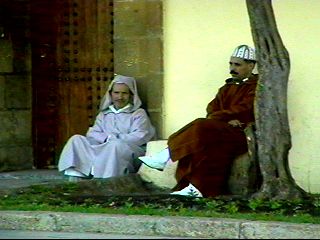
The spirit of free enterprise. We turned a corner in the Fes medina, and there was this boy, sitting backwards on a donkey. This was definitely a photo opportunity! And a money-making opportunity for the boy. He asked (and received) five dirhams for the photo.

We had been warned that many Moroccans do not like to have their picture taken. Indeed, groups of women would hide or wave us off if a camera was pointed even vaguely in their direction. On the other hand, people in picturesque situations were quick to demand payment for the use of their image.

There were children everywhere. We should not have been surprised, more than 50% of Morocco's 30 million are under 20. Some were shy and avoided our glances, but most were eager to run up and greet us, "bonjour monsieur, bonjour madame", and they would gaze up with their big brown eyes. And then they would demand "un dirham".

Sociology of Pierre Bourdieu 1930-2002

The background of Pierre Bourdieu is a departure from Marxism and coming closer to Weber. He was still a radical. Class dominance gets challenged at the superstructure level, therefore not directly on economic class interests but at the level of the cultural. As with Weber, social ideas generate their own partial autonomy. People have class interests but those with the most capital surpluses can trade them in for symbolic capital in order to buy future power or tying others in now.    
Economic capital is equities and surpluses in high business salaries; social capital is high among the communicating networking of high social status people; cultural capital is in educational degrees and socially considered aesthetic quality; and symbolic capital is a form of honour and loyalty. These capitals can have their own surpluses, their own storage as if in some imaginary bank (as well as real banking for the economic) and can be traded.
Whilst he drew on Levi-Strauss' structuralist anthropology for objective structure, he found it dead to action and agency (like an individual social actor), unlike with his use of subjective existentialism. So he wanted the two combined, where people acted (more than just following structural rules) within a received objective world.
Bordieau was moving beyond the celebrated continental structuralism before Giddens' structuration theory and Bhaskar's transformational model of social action, both of which also tried to break the division between subjectivism and objectivism, using both Wittgenstein and phenomenology, and seeing strutures as enabling as well as constraining.
Actors do not engage in the precision of rational choice theory; they do still set out to maximise returns for themselves and their own in a utilitarian fashion. People might not make rational choices as if they are rational agents, but they do operate skilfully and practically according to the shared understanding they receive in specialities. In this Bourdieu draws upon social phenomenology, Heidegger and the later Wittgenstein as well as Goffman. It is not acting according to explicitly known theory, nor is it always conscious. The taken-for-granted mental world prior that leads directly to a good overall feel for it and acting according to the practical knowledge therein is called Doxa. This echoes views of Peter Berger and what constitutes the sociology of knowledge. Doxa is also like a deep paradigm. Heresiarchs can crack any one doxa: they might be a group within a high social status ruling class with plenty of cultural capital but little economic capital, like the poor, heroic, serious artist.
The basis of how symbolic capital works was Marcel Mauss' work The Gift, so that the symbolic exchange that takes place has a binding effect. Honour and loyalties get bound together within social systems of exchange. For Bourdieu, economic capital is converted into symbolic capital in order to gain sufficient obligation back and create relationships of dependence from lower social classes. Also economic capital can be deferred via symbolic capital, for example in purchasing education for one's own offspring which costs money but is rewarded by reproducing the family in high status positions. Cultural capital works via superior aesthetic taste, and that taste relates to social position: actual preferences relate to social status. These different categories of capital emphasise that (like for Marx) capital is a form of social relation.
This receiving and social acting begins in childhood, with dispositions of perception, thought and actions towards practices, improvisations, attitudes or bodily movements, and dispositions combine to generate habitus of a practical sense of the world by which all sorts of action strategies can be generated.
Just as Wittgenstein had different language games so Bourdieu understands the divisions of more practical knowledge into fields. Dispositions then are effectively socialisation and habitus is having gained the social world of that field into one's mental make-up. Dispositions are adjusted by the continuing constraints of the social world actually inhabited, including those constraints specific to social status. Thus the combining into a habitus is affected too, and therefore action back into that social world.
The work of Basil Bernstein is relevant here. His suggesting once strong contextualised transmission of middle class values and later weaker transmission of values based on work orientation, comes into this understanding of dispositions; then also comes habitus and having a whole grasp of dispositions among middle class members and therefore the strategies of speaking in elaborate and restrictive codes that give advantage to the middle class. (Care is needed here with a terminology clash: Bourdieu's use of restricted is for high cultural value art whereas expanded is mass art that does not require specialist decoding).
People therefore become acclimatised, skilled operators in their social fields rather like a person drives a car. Most of the time it seems semi-conscious once learned, and social status and power reproduces itself.
The inflexibility of dispositions and durability of each habitus do not account for change so well. So this approach is good for suggesting how things reproduce and stay the same, but not so good for explaining change.
Bourdieu is useful for considering always that the economy is also a symbolic and cultural activity, and utiility lies in these. In terms of consumption it is of course all about taste (utility is ultimately a psychological term of satisfaction in rational choice economic theory), and his postmodern notion is that aesthetics are determined by social position and do not have Kantian independence. Taste is collective. In terms of production those who avoid the mass market can earn the cultural capital of insiders' approval and this can be traded for economic capital with some loss of status (a good example could be how Jack Vettriano sells a lot of his paintings but is regarded as having low cultural capital among artists). Avant garde art is at first seemingly opposed to the economy of commercial production (as in art is sacred and "consecrated" whereas volume production is profane) - until of course the cultural production of this art is recognised as having its own logic of a higher value higher risk economy than the pumping out of prints and popular styles with a clearly more mass economic objective. Who buys cultural value art? Once again it is people of high status who can defer their economic capital into symbolic capital, and who demonstrate their social status derived aesthetic value. Some art is bound to be more economic and popular: cinema, photography and jazz could never return enough cultural capital. Bourdieu about television spoke of "cultural fast food"
Bourdieu has a methodological impact. Theory has to be grounded in research. He did not agree with sociological models that paid little attention to actual empirical realities. Distinction: A Social Critique of the Judgment of Taste was empirical study of taste within social classes and looking at the uneven distributions of aesthetic dispositions. Such capital upholds social authority. He showed social dominance in research findings (especially in education) and how superiority was shown in a process of symbolic reproduction among the socially favoured with a beneficial habitus for them (over working class habitus) generating better strategies. His study of his own locality of peasants in Béarn and why some did not marry was historical as much as sociological.
Bourdieu introduces the notion of participant objectivation. The area of research is an objective world of the habitus. It is important also in this processes to get inside people's motives for actions - their own skills and abilities in acting. Thus objective and subjective are combined. Furthermore, the researcher is not an all seeing objective eye, but should be self-critical in one's own presuppositions. This approach is called doing reflexive sociology.
There are a number of criticisms to consider.
First of all it is quite possible to have high cultural capital surpluses and high economic capital surpluses. The works of Jane Austen have not lost their high cultural capital simply because they sell alot. Nor do great works of art have to sell for less because people buy endless books or posters with them on show. Also categories of art vary internally in their cultural capital: there are art versions of cinema, photography and jazz. Of course Bourdieu discusses a rarified community keeping up its social role by producing academically interpreted artwork. It may be, though, that the dynamics of the art market are purely to uphold savings: that a class of people trade in money-absorbing artworks of no particular value other than in their money-holding role. A widespread view that some art is "just crap" must diminish their cultural value, as with the Turner Prize and the constant need to defend it, but these artworks continue to trade and be emblems of wealth, and carry on demanding high prices for passing between the wealthy and institutions.
Secondly there seems to be some overlap in symbolic and cultural capital. If cultural capital is socially derived then its task is to uphold social status and is a purchase. Visits to the opera have this social role, in the UK, via high seat prices and so some people identify with it. Culture is symbolic anyway, and art joins music in being less precise symbolic forms of expression than words. Education is more than investment in forms of reproducing honour, but is an investment into the cultures of words and skills with presentation strategies that translate into social and economic gain. Presumably networking is a social capital to be transferred into other forms of capital, and is akin to being in a profession, meant in broad sociological terms of a restricted membership of people where members approve new recruits according to its ethos that may involve training and socialisation into it (thus including, sociologically, a "profession" of artists). Professions, of course, set up scarcity and therefore high fees (whatever the ethics of the product being purchased, including that of profession-regulated, service-based, honest advice). Allowing for this kudos of association, I would suggest three forms of capital - economic, social and symbolic, the latter including the cultural.
Thirdly there is some lack of clarity about the terms doxa, dispositions and habitus, and quite when fields are employed or something more total and holistic is being discussed, and one wonders whether there is a need for all these terms at all. Dispositions have a kind of cod-psychology about them; both dispositions and habitus are the process of socialisation and the separation of these seems more analytical than real. The objective-subjective combination is that we have society in our individual heads and that we remain individuals in society with some freedom to act creatively. Furthermore if doxa is a deep paradagm (deeper than Kuhn's understanding) then habitus is a merging of doxa and habitus - society in the individual mind. Once we have dispositions, are we not then socialised into the doxa as we achieve habitus? The habitus is then waiting for us to, well, inhabit it. So perhaps just two terms could suffice - fields and habitus. Nor do we always intend to act in some utilitarian manner by increasing stocks of different forms of capital, and arguably some forms of capital as described are not utilitarian. The material-spiritual exchange that Marcel Mauss discusses might be called utilitarian at one level, but given the material-spiritual difference it might be called sacrificial or even tribal.
Bourdieu represents an approach to cultural theory, grounded in the empirical and what groups of people do, to be discovered by participant objectivation (why not participant observant objectification?). He tries to set this out logically through use of plenty of terminology. Well, here is the reflexive part: he is trying to acquire symbolic (including cultural) capital of the sociologists with whom he networked, by using his own rarified analytical terminilogy for their academic approval, when it might be a lot simpler and presentable to more people. It might sell a few more books if it did become clearer, and it might be more coherent and therefore increase both its economic and symbolic capital.

Pierre Bourdieu was born 1 August 1930 in the Béarn area of France. He died January 23 2002 from cancer. He studied Philosophy at the École Normale Supérieure under Louis Althusser and was a schoolteacher at Moulins between 1955 and 1956. Then for two years he was conscripted into the military in Algeria and wrote Sociologie d'Algérie, the Algerians, published in 1958, as a result - looking at the Berbers under colonialism and seeing what their original kinship structres were. These structures were at variance from social action, and so structure and action needed to be combined. He went on to teach at the University of Algiers to 1960 and on to universities at Paris and Lille up to 1964. A longer job was from 1964-1981 as Director of Studies at École Pratique des Hautes Études as well as being Director of the Centre de Sociologie Européen from 1968 and becoming Professor of Sociology at the Collège de France in 1981. Bourdieu was anti-globalisation and fought against neo-liberal dominance.